FPV
Why One-Take FPV Feels So Immersive
The reason an unbroken flight reads as a real space in a way cuts never do.
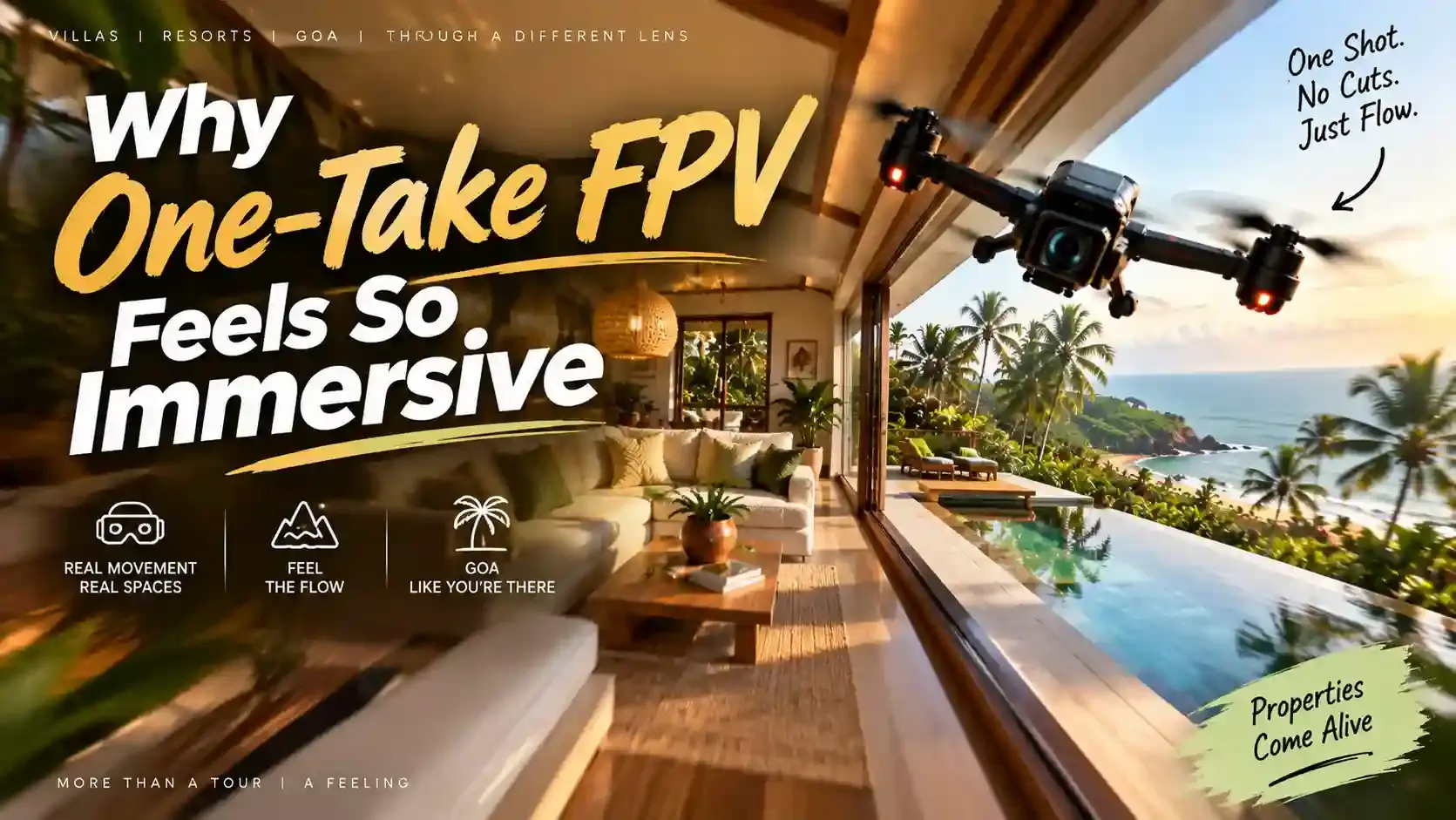
Watch a cut-heavy property video and you remember images. Watch a single continuous flight and you remember a place. The difference is not production value, and it is not the camera — it is continuity.
Continuity builds a map
Given unbroken motion, a viewer assembles a spatial model almost automatically: this room is behind that one, the pool sits to the left of the deck, the bedrooms are further from the road than they looked. Every cut discards part of that model and quietly asks them to start again.
This is why a montage of beautiful frames can leave somebody feeling they have seen a lot and understood very little. The frames were never joined, so nothing accumulated.
Motion carries intent
A flight path is a decision about where attention goes and in what order. Slowing at a doorway says this threshold matters; accelerating down a corridor says this part is just the route. Pace does the work a voiceover would otherwise have to do, which is why the good ones need no narration.
Why it has to be flown, not faked
The effect depends on the movement being real and uninterrupted. Stitching clips to imitate it tends to show — a shift in parallax, a hitch in the speed, a light level that jumps — and the moment a viewer senses the seam, the space stops feeling real. They may not be able to name what went wrong. They will still stop believing it.
That is also why the shot is difficult and why comparatively few operators fly it. There is no way to assemble it afterwards. It either happened in one take or it did not.
Where the format does not help
It is worth being straight about the limits. A one-take flythrough is poor at detail — the texture of a fabric, the finish on a tap, the view from one specific window at one specific hour. It moves past things by design. That is what a photographer is for, and it is why the two sit alongside each other rather than competing.
If you want to judge the effect rather than read about it, the films on the FPV property flythrough page are one continuous take each.
Frequently asked questions
- What does one-take actually mean?
- That the delivered film is a single continuous flight with no cuts in it — the camera travels from the first frame to the last without the edit jumping. It is not a sequence of clips assembled to look continuous.
- Can a normal drone do the same thing?
- Not really. A conventional camera drone is built for stability and height, which makes it excellent at wide establishing shots and poor at travelling through a doorway and along a corridor. An FPV drone is flown by hand and built for movement through a space, which is what the one-take format requires.
- Can you fake a one-take with editing?
- People try, and it usually shows — a shift in parallax, a hitch in the speed or a jump in light level. Viewers rarely identify what is wrong, but the illusion of a real space collapses anyway, which defeats the reason for shooting it this way.
- Is a flythrough enough on its own?
- For showing layout and flow, yes. For detail — materials, finishes, a particular view at a particular hour — it is the wrong tool, because it moves past things by design. Most properties are best served by a flythrough alongside stills rather than by either on its own.
Related service: FPV property flythroughs