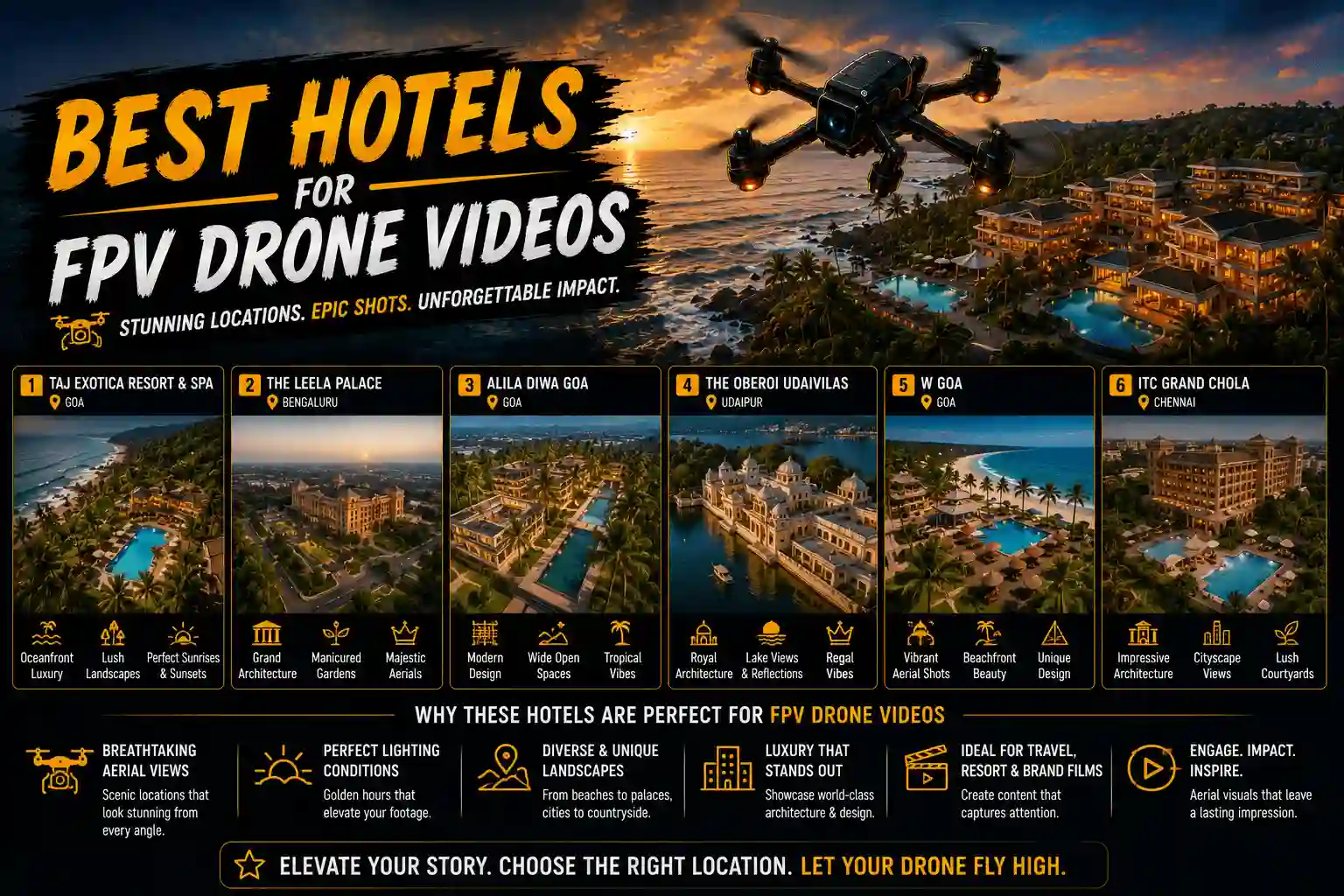
The Best Hotels for FPV Drone Videos in Goa
Luxury hospitality is no longer just about providing a bed; it's about selling an experience. In the Goa hotel market, where competition is fierce, static photography and standard wide-angle drone shots have become noise. To capture the attention of a high-value traveler, hotels are turning to FPV (First Person View) drone videography to create immersive, cinematic narratives that drive direct bookings.
1. Communicating Scale and Spatial Logic
The biggest challenge for a large resort is showing how the amenities relate to each other. A traditional drone captures a "flat" map of the property. An FPV drone, however, can:
- Dive from the Canopy: Start high above the jungle canopy, dive down to the pool deck, and skim the water surface in a single, flowing motion.
- Reveal the Journey: Follow the path a guest would take, from the grand entrance, through the lush gardens, and straight into their private infinity pool.
- Contextualize the Location: Show exactly how close the resort is to the beach or river, providing a 1:1 sense of place that builds immediate trust with the viewer.
2. The Interior Walkthrough: No More Static Rooms
Standard hotel room videos are often repetitive. With Cinewhoop drones—small FPV craft with ducted propellers—we can fly safely through the interior of the resort.
We can navigate through high-ceiling lobbies, weave between dining tables at the resort restaurant, and glide through the sliding doors of a luxury suite. This "one-take" walkthrough style mimics the human eye but with the speed and agility of a bird, making the viewer feel as though they are already exploring the hotel.
3. Technical Challenges: Signal Integrity & interference
From a technical perspective, hotels are "dirty" RF (Radio Frequency) environments. Large resorts use dense WiFi mesh networks and cellular repeaters that can interfere with a drone's control link.
As a pilot, I perform a full Signal Audit before every shoot. We identify "blind spots" caused by thick heritage walls or metal structures. Using high-output digital transmission systems ensures that the 4K feed remains stable even when the drone is deep inside a stone-walled Portuguese villa.
4. Logistics and Guest Privacy
The most beautiful hotels in Goa are often the most crowded. To achieve the "Ghost Background" look where the resort appears as a private sanctuary, we coordinate Sunrise Sessions.
Flying at 6:00 AM allows us to use the best natural light while ensuring zero disturbance to guests. We also work closely with hotel security to ensure all flight paths are cleared, making the production seamless and professional.
Technical Suitability: FPV vs. Standard Media
To understand the marketing ROI of hospitality drone videos, compare the technical output:
| Feature | Standard Hotel Video | FPV Cinematic Reel |
|---|---|---|
| Viewer Retention | Low (Frequent Cuts) | High (Continuous Flow) |
| Indoor Navigation | Impossible (Tripod Only) | Full (Cinewhoop Access) |
| Perspective | Third-Person (Observer) | First-Person (Immersive) |
| Emotional Hook | Functional Information | Experiential Storytelling |
Is your hotel ready for a cinematic upgrade?
Book a Resort Flight AssessmentFrequently Asked Questions for Hoteliers
-
Is the drone noisy enough to disturb guests?
We minimize disturbance by shooting during pre-authorized windows (usually sunrise) and using small, quiet Cinewhoop builds for any interior shots. -
How long does a full resort shoot take?
A comprehensive FPV edit usually requires two sessions: one at sunrise for exterior and landscape flow, and one during the day for controlled interior walkthroughs. -
Can we use the footage for Instagram and YouTube?
Absolutely. We deliver high-bitrate 4K files in both 16:9 (YouTube/TV) and 9:16 (Reels/TikTok) formats to ensure your marketing is covered across all platforms.