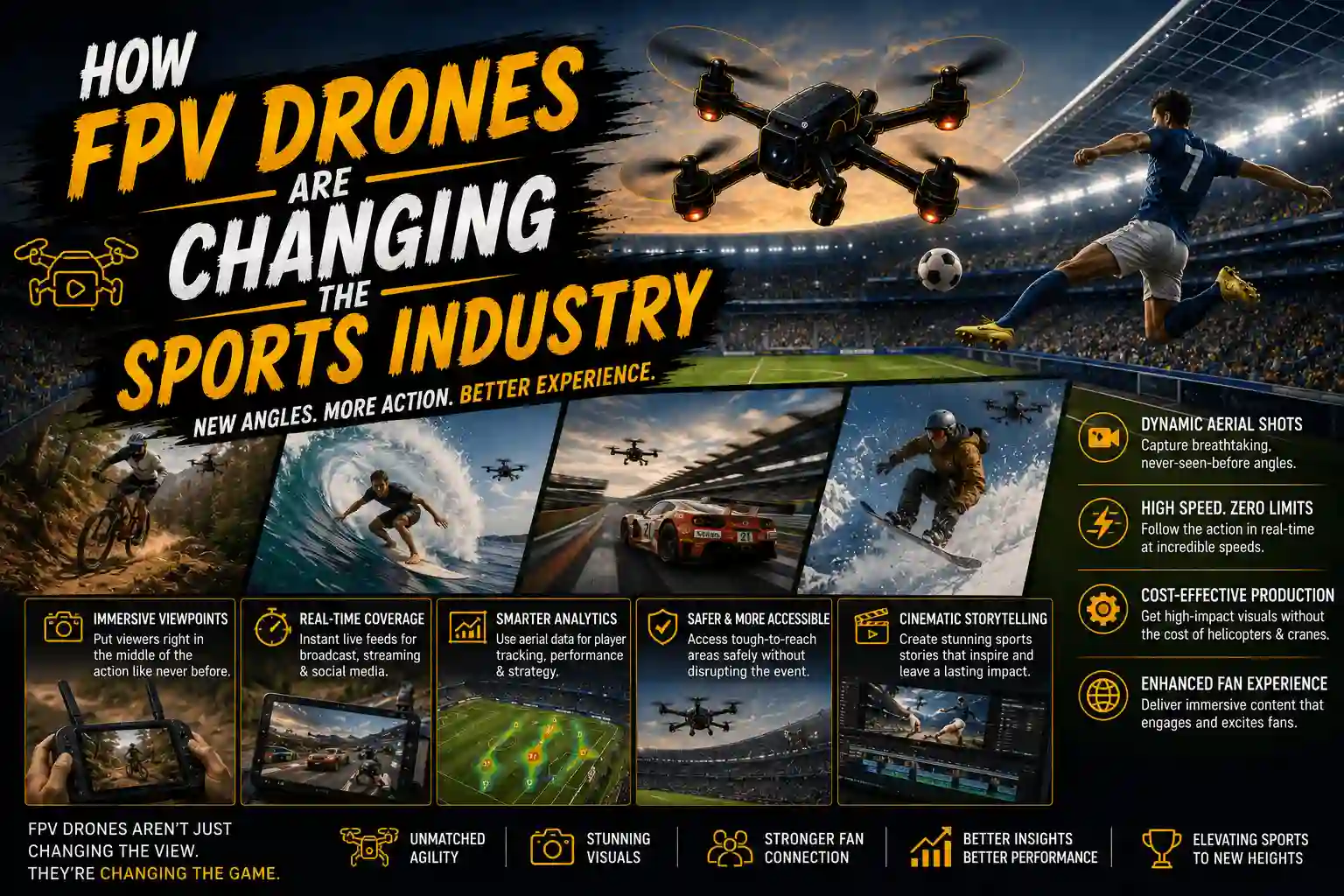
How FPV Drones are Changing the Sports Industry
The sports industry has always been a race for the best perspective. From the first handheld cameras to massive stadium "Spidercams," the goal is to make the fan feel like they are in the game. But traditional cameras have limits—they are heavy, bound by cables, or too slow to match the speed of the elite. Enter FPV (First Person View) drone videography: the technology that has officially removed the glass wall between the athlete and the audience.
1. High-Speed Proximity Tracking
Standard drones are restricted by GPS-locked speed limits and collision sensors that force them to stay away from the action. FPV drones are fully manual, high-performance machines that thrive in the "Danger Zone."
In sports like drifting, mountain biking, or Formula 1, a pilot can fly the drone within inches of the athlete at speeds exceeding 100 mph. This provides a visceral, physical sense of speed that a long-lens camera from the sidelines simply cannot replicate. The drone banks into turns exactly like the subject, creating a synced visual flow that makes the viewer's heart rate spike.
2. The Evolution of Live 4K Broadcasting
The biggest shift in the last 24 months is the move from recorded highlights to Live FPV Feeds. With high-bitrate digital transmission systems, FPV drones are now integrated into professional broadcast trucks.
Directors can now cut to a drone feed during a live event, providing a "fighter pilot" view of a downhill ski run or a golf ball's flight path. This has transformed viewer retention, as the dynamic movement of FPV is inherently more engaging for a digital-first generation used to high-speed social media content.
3. Stadium and Arena Immersion
Beyond the speed, FPV is being used to build the Brand Narrative of sports teams. One of the most famous examples is the "One-Take Stadium Fly-through," where an FPV drone starts in the parking lot, flies through the locker room, weaves between the players' legs during warmups, and emerges into the roaring arena.
This style of filmmaking humanizes the athletes and gives fans "access" to restricted areas. For sports organizations in Goa and India, this is the ultimate tool for season-ticket marketing and sponsor activations.
4. Extreme Sports: The Goa Perspective
In Goa, FPV drones are finding their home in Water Sports and Adventure Tourism. Tracking a kite-surfer across the Morjim coastline or a paraglider off the cliffs of Vagator requires the agility that only FPV can provide.
Because FPV drones can handle high winds and are small enough to "duck" under waves or through tree canopies, we are able to document the local sports scene with a cinematic quality that was previously reserved for Red Bull-budget productions.
Technical Comparison: FPV vs. Traditional Sports Cams
To understand why broadcasters are making the switch, look at the technical flexibility:
| Capture Metric | Cable Cam / Spidercam | FPV Sports Drone |
|---|---|---|
| Max Speed | ~35 mph | 100+ mph |
| Setup Time | 2-3 Days (Rigging) | 15 Minutes |
| 3D Agility | 2D Plane (Cables) | Full 3D Freedom |
| Cost ROI | High Infrastructure Cost | High Content Output |
Do you need to track high-speed action in Goa?
Book a Sports Drone SessionFrequently Asked Questions about Sports FPV
-
Is the drone dangerous for the athletes?
Safety is non-negotiable. For proximity sports, we use Cinewhoops with propeller guards. For high-speed chases (cars/boats), we maintain a calculated safety gap that allows for the lens compression to make the shot look closer than it is. -
Can FPV drones track a ball in flight?
Yes. Skilled pilots can track objects as small as a golf ball or a cricket ball, though this requires high-frame-rate cameras (120fps+) to ensure the object remains clear in the final edit. -
What happens if the drone crashes during a live
event?
We operate with redundant systems and a "Spotter" who monitors the airspace. If a drone fails, we can have a backup in the air in under 60 seconds.